
The Boston Boat Owner’s Guide to Lithium:
What every captain needs to know before switching chemistries.
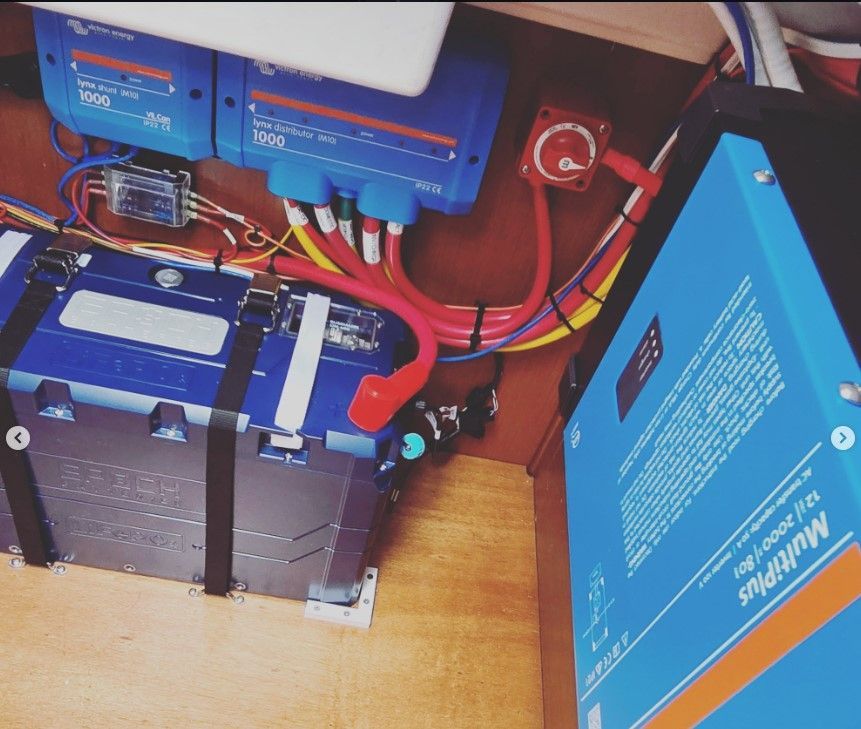
If you’ve spent any time at the marina lately, you’ve heard the gospel of Lithium Iron Phosphate (LiFePO4). The promises are seductive: half the weight, double the usable energy, and a lifespan that might outlast your interest in the boat itself.
But here’s the professional opinion that ruffles feathers: Most "drop-in" lithium upgrades are anything but.
At M.P. Marine, we see it constantly. A boat owner buys a few blue or black boxes online, swaps the cables, and wonders why their alternator is smoking three miles offshore. Switching to lithium isn't just a battery swap; it’s a total system evolution. Here is what every captain needs to know before making the leap.
1. The Alternator "Death Wish"
Standard marine alternators are designed to charge lead-acid batteries, which have high internal resistance. As lead-acid batteries charge, they naturally push back, limiting the current.
Lithium batteries have almost zero internal resistance. They are "thirsty." They will attempt to pull every single amp your alternator can produce until the alternator literally melts its own internal insulation.
The Fix: You must install a DC-to-DC charger or an external regulator with an alternator temperature sensor. If you don't, you aren't upgrading your boat; you're just timing a countdown to a mechanical failure.
2. ABYC E-13: The New Gold Standard
The American Boat and Yacht Council (ABYC) recently released E-13, the dedicated standard for Lithium-Ion batteries. This isn’t just "nerd talk"—it’s what your insurance surveyor is going to look for.
BMS Communication: Under E-13, your Battery Management System (BMS) must be able to issue a "pre-shutdown" warning before it disconnects. Why? Because if your BMS suddenly cuts the circuit while your engine is running, the resulting voltage spike (load dump) can fry your expensive GPS, radar, and engine ECU in milliseconds.
3. Forget Everything You Know About "Voltage"
With lead-acid, you can tell your state of charge by looking at a voltmeter. 12.6V is full; 12.2V is half-empty.
Lithium has a "flat discharge curve." It will stay at roughly 13.2V until it is nearly dead, at which point it falls off a cliff.
The Reference: Per ABYC E-11, any system with significant capacity should utilize a shunt-based battery monitor (like the Victron BMV series) to track current (Ah) rather than just voltage. If you’re guessing your capacity based on a standard dash gauge, you’re flying blind.
4. The Cold Hard Truth (Literally)
You cannot—and I mean never—charge a lithium battery when the internal cell temperature is below freezing ($32^\circ F$ or $0^\circ C$). Doing so causes "lithium plating," which permanently kills the battery and creates a fire hazard.
Pro Tip: If you boat in New England or late into the season, ensure your batteries have internal heating elements or are located in a conditioned space.
The M.P. Marine Verdict
Lithium is a game-changer for off-grid living, silent nights without a generator, and faster charging. But it requires a holistic approach. You need to look at your wire gauges (voltage drop matters more than ever), your charging profiles, and your safety shut-offs.
Ready to cut the cord? Don't risk your vessel's electronics on a DIY "drop-in" project. M.P. Marine specializes in ABYC-compliant lithium integrations using premium components from Victron Energy and Epoch. We provide full system diagrams and a post-install orientation so you actually know how your new "power plant" works.